2 min read
GAM Tech Recognized Top 20 Cisco Solutions Providers!
According to a recent article published in the CIOReview, GAM Tech is among a select number of companies at the forefront of providing CISCO solutions
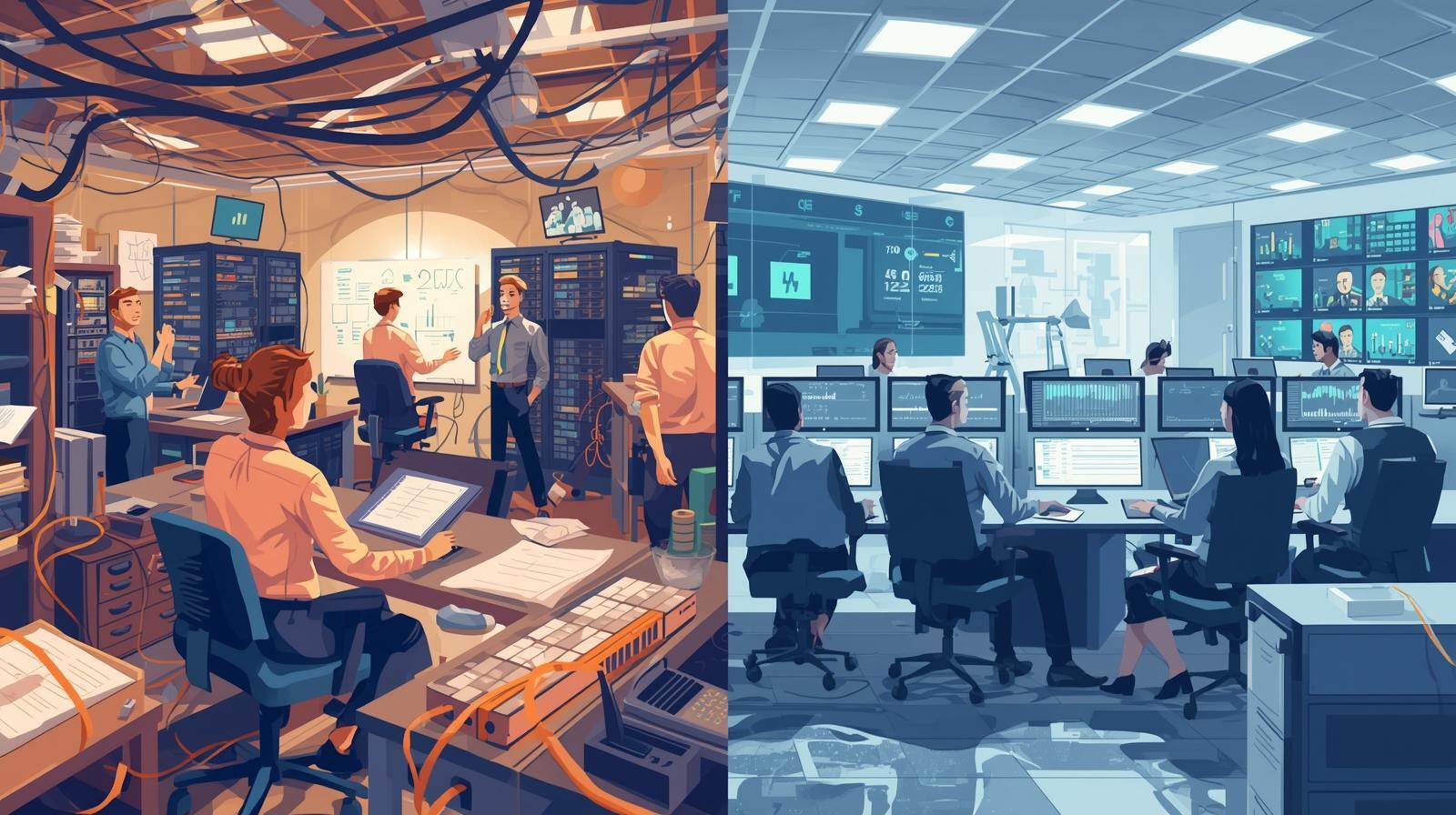
Every business owner we talk to eventually asks the same question: “Should we hire our own IT person, or should we work with a managed IT provider?”
It’s a fair question. On the surface, having someone on staff who knows your systems inside and out sounds appealing. They’re right there, they know your people, and they’re dedicated entirely to your business.
But the reality of that equation in 2026 is very different from what it was even five years ago. The cybersecurity landscape has transformed what “managing IT” actually requires. Compliance obligations are expanding. Cloud and hybrid environments demand specialized expertise. And the cost of a single in-house hire when you factor in everything it takes to actually deliver the IT coverage a modern business needs is significantly higher than most business owners realize.
At GAM Tech, we’re not going to pretend this is an unbiased comparison we’re a managed IT provider, and we believe strongly in the model we deliver. But we’re also going to give you the honest numbers, including the scenarios where in-house IT genuinely makes more sense. Our goal is to help you make the right decision for your business, not to sell you something you don’t need.
Let’s break it down.
Most business owners think about the cost of in-house IT in terms of salary. But salary is typically only 50–60% of the total cost of employment, and it doesn’t account for the tools, training, and infrastructure that person needs to do their job effectively.
Here’s what you can expect to pay for IT talent in Canadian markets in 2026, based on current market data. These are approximate ranges that vary by city, experience level, and demand:
In cities like Calgary, Edmonton, Vancouver, and Toronto, salaries tend to be at the higher end of these ranges due to competition for technical talent. And these are base salaries before benefits, overhead, and the tools they need to do the work.
It’s also worth noting that these ranges have increased meaningfully over the past two years. The Canadian IT talent market is tight, and qualified cybersecurity professionals in particular command premium compensation. A security analyst who was earning $90,000 in 2023 is likely earning $110,000 or more today. That’s a market reality that directly impacts the cost comparison.
For every dollar you spend on an IT employee’s salary, expect to spend an additional 25–35% on associated costs. For an IT manager earning $120,000, the total cost of employment typically looks like this: salary at $120,000, benefits including health, dental, disability, and retirement matching at $24,000 to $36,000, payroll taxes and workers’ compensation at approximately $10,000, professional development and certifications at $3,000 to $8,000, and recruitment costs including job postings, interviews, and potential agency fees averaging $5,000 to $15,000.
Before your IT manager has touched a single system, you’re looking at $162,000 to $189,000 in annual cost. And we haven’t talked about tools yet.
There’s also an opportunity cost that’s easy to overlook. The time you and your management team spend recruiting, interviewing, onboarding, managing, and retaining an IT professional is time you’re not spending on your core business. For a business owner who’s already wearing multiple hats, adding “IT department manager” to the list has a real cost, even if it doesn’t show up on a line item.
A competent in-house IT person needs tools to manage your environment effectively. Remote monitoring and management software runs $3,000 to $8,000 per year. Endpoint security and EDR tools cost $5,000 to $15,000 depending on the number of devices. A backup and disaster recovery solution runs $5,000 to $20,000. Ticketing and documentation systems cost $2,000 to $5,000. Security awareness training platforms run $1,000 to $4,000. And various other tools for patching, vulnerability scanning, and network monitoring add another $5,000 to $10,000.
That’s $21,000 to $62,000 in annual tool costs on top of the personnel costs. And these aren’t optional tools they’re the baseline of what’s needed to manage a modern IT environment responsibly. Without them, your IT person is flying blind.
A managed IT provider already owns and operates these tools at scale across their entire client base. The per-client cost of enterprise-grade tooling is dramatically lower when it’s amortized across hundreds of clients. That’s one of the fundamental economic advantages of the MSP model. You get access to the same calibre of tools that large enterprises use, without bearing the full cost yourself. And because the MSP’s team uses these tools daily across many environments, they develop expertise in maximizing the value of each tool that a single in-house hire simply can’t match.
Here’s the challenge that most business owners don’t fully consider until it’s too late: one person cannot provide the coverage a modern business needs.
Your single IT person gets sick. They go on vacation for two weeks. They have a family emergency. They decide to take a new job with three weeks’ notice. In all of these completely normal scenarios, your business has zero IT support. No one is monitoring your systems for security threats. No one is responding to employee issues. No one is watching for the signs of a cyber attack.
And that’s before we talk about after-hours coverage. If your business operates beyond 9-to-5 or if you simply need the assurance that a ransomware attack at 2 AM will be detected and responded to one person cannot deliver that. You’d need a minimum of two to three people to provide reliable coverage outside business hours, which doubles or triples your personnel costs.
We see this play out regularly with new clients. A 110-person manufacturing company in Edmonton came to us after their sole IT person resigned with two weeks’ notice. During the three months it took to find a replacement, their systems went unmonitored. A failed backup wasn’t detected for six weeks. A security vulnerability in their VPN went unpatched for two months. They were lucky that nothing catastrophic happened during that window but luck isn’t a strategy.
Another client, a 65-person logistics company in Red Deer, had their IT manager go on medical leave unexpectedly. The company had no backup plan. They called us for emergency support, and during the initial assessment we discovered that critical Windows updates hadn’t been applied in over a month, three user accounts that should have been disabled when employees left were still active, and the email security configuration had been partially changed and never completed. These are the kinds of things that accumulate silently when your single point of IT coverage disappears.
In 2026, “IT” isn’t a single discipline. It encompasses cybersecurity, cloud architecture, network management, endpoint management, compliance, backup and disaster recovery, vendor management, and strategic planning. No single person is an expert in all of these areas. Your in-house IT manager might be excellent at systems administration but have limited cybersecurity expertise. They might be strong on Microsoft 365 but struggle with network architecture.
When a specialized need arises and it will your in-house person either spends time learning on the job (which means other things aren’t getting done) or you bring in an outside consultant at $150–$300 per hour. Either way, you’re paying for the expertise gap.
Consider a concrete scenario: your business needs to achieve SOC 2 compliance because an enterprise client requires it as a condition of doing business with you. Your in-house IT manager has never been through a SOC 2 audit. They need to research the requirements, identify the gaps in your current environment, implement the necessary controls, create the documentation, and coordinate with the auditor. This is a project that could take months of their time months during which their regular responsibilities aren’t getting done or are getting done at a lower standard. A managed IT provider with SOC 2 experience handles this routinely and can guide you through the process while continuing to deliver day-to-day support without interruption.
Managed IT services in Canada are typically priced on a per-user-per-month basis. The range varies based on the scope of services included, the complexity of your environment, and the provider’s capabilities, but here’s a general guide:
Basic monitoring and help desk: $80 – $130 per user per month
Standard managed IT with security: $130 – $200 per user per month
Comprehensive managed IT with advanced security, compliance support, and strategic planning: $180 – $275 per user per month
For a 75-person company on a comprehensive plan at $200 per user per month, that’s $15,000 per month or $180,000 per year. At first glance, that might seem comparable to the cost of a single in-house IT manager. But here’s what you’re getting for that investment: an entire team of specialists covering help desk, cybersecurity, cloud, infrastructure, and strategic planning; 24/7 monitoring and support with defined response time commitments; enterprise-grade security tools included in the price; backup and disaster recovery infrastructure; compliance documentation and audit support; and vendor management for your technology partners.
That’s not one person. That’s a department. And you’re getting it without the recruitment risk, the single-point-of-failure vulnerability, the expertise gaps, or the coverage holes that come with a single hire.
At GAM Tech specifically, our model includes several elements that make the comparison even more favourable. Our 24/7 internal support comes with a 5-minute response time commitment that’s not an average, it’s our standard. Our Project Packs cover common projects within your agreement rather than billing them separately, which means routine projects like office moves, new employee setups, and system migrations don’t generate surprise invoices. And our Hardware-as-a-Service program provides enterprise-grade hardware through a predictable monthly cost with built-in refresh cycles, removing the capital expenditure spikes that make IT budgeting unpredictable.
The mistake most people make when comparing in-house IT to a managed provider is comparing the cost of one IT person to the cost of an MSP contract. That’s not an equivalent comparison because one IT person doesn’t deliver the same capabilities as a managed IT team.
Here’s a more accurate framework. Ask yourself what your business actually needs in terms of coverage hours is business hours only genuinely sufficient, or do you need 24/7 monitoring and support? What expertise areas do you require — just help desk and basic administration, or cybersecurity, cloud management, compliance, and strategic planning as well? What are your response time expectations? And what are your scalability requirements over the next 24 months? Then price out what it would cost to deliver those capabilities in-house versus through a managed provider.
Let’s run a realistic example. A 75-person professional services firm in Calgary needs business-hours help desk support with after-hours emergency coverage, cybersecurity monitoring and incident response, backup and disaster recovery, Microsoft 365 administration, and quarterly strategic technology reviews.
To deliver this in-house, you’d need at minimum an IT manager at $120,000 to $140,000 salary, a help desk technician at $50,000 to $65,000 salary, benefits and overhead at 30% adding another $51,000 to $61,500, tools and licensing at $35,000 to $55,000, and an outsourced after-hours monitoring service at $1,500 to $3,000 per month ($18,000 to $36,000 annually). That’s a total of $274,000 to $357,500 per year and you still have gaps in cybersecurity expertise, limited redundancy, and no coverage if both people are out simultaneously.
A comprehensive managed IT engagement for 75 users at $200 per user per month costs $180,000 per year and delivers all of the above plus a full team of specialists, true 24/7 coverage, enterprise-grade tools, and built-in redundancy. The cost saving is $94,000 to $177,500 per year while delivering materially more capability.
For most businesses with 20–200 users, the math strongly favours a managed provider not because MSPs are cheaper in absolute terms, but because they deliver dramatically more capability per dollar.
Five years ago, decent antivirus, a firewall, and good password practices were a reasonable security posture for a small business. In 2026, with AI-powered attacks, ransomware-as-a-service, and supply chain compromises, effective cybersecurity requires threat monitoring, EDR/MDR, security awareness training, incident response planning, vulnerability management, and compliance documentation. That’s a team’s worth of work, not one person’s. As we covered in our blog on AI-powered cyber attacks earlier this month, the threat landscape has industrialized. Your security approach needs to match.
With Canada’s privacy laws tightening, your IT infrastructure needs to support compliance with documented processes, access controls, breach detection capabilities, and audit trails. An in-house IT person might implement the right technical controls, but creating and maintaining the documentation and processes that demonstrate compliance is a separate workstream that requires specialized knowledge. The new federal privacy framework and Bill C-8 cybersecurity requirements are raising the bar on what “compliance” means for Canadian businesses.
Cyber threats don’t operate on business hours. Neither do your employees in a remote or hybrid work environment. The expectation for 24/7 IT support and security monitoring has shifted from “nice to have” to “necessary.” Staffing that internally requires multiple people and a formal on-call rotation. An MSP provides it as part of their standard service because they’re already staffed around the clock for their entire client base.
Most businesses now operate in a hybrid environment with some on-premises infrastructure, multiple cloud platforms, and remote access requirements. Managing this environment effectively requires expertise in cloud architecture, identity management, network security for distributed environments, and integration between on-premises and cloud systems. This is specialized knowledge that many generalist IT professionals don’t have, and the technology evolves rapidly enough that staying current is a significant ongoing investment.
We onboarded a 85-person engineering firm in Vancouver that had been relying on a single IT administrator for three years. The administrator was excellent at on-premises server management and desktop support, but the company’s migration to a hybrid cloud environment had exposed significant gaps. Azure Active Directory was misconfigured, conditional access policies hadn’t been set up, and the VPN architecture hadn’t been updated to reflect the new cloud workloads. None of these were the administrator’s fault they were simply outside his area of expertise. Within two months of our engagement, we had reconfigured the cloud environment, implemented proper identity management, and reduced their monthly Azure spend by 22% by right-sizing resources that had been over-provisioned.
Businesses don’t grow linearly. You might acquire a company, open a new office, or onboard a major client that doubles your IT requirements overnight. An in-house team scales by hiring, which takes weeks or months. A managed provider scales by adjusting your service plan, which can happen in days.
One of our clients, a 60-person recruitment agency in Toronto, acquired a 30-person competitor and needed to integrate their IT environments within 45 days to meet contractual obligations. Their previous IT setup couldn’t have handled this the integration required network consolidation, email migration, security standardization, and user onboarding at a pace that would have overwhelmed a single IT person. Because they were with GAM Tech, we stood up a project team, built a migration plan, and completed the integration on schedule without disrupting operations at either company.
In the interest of honesty, here are the scenarios where building an internal IT team is the better choice:
Large organizations with 200 or more users and complex proprietary systems that require deep institutional knowledge and daily on-site presence.
Companies with the budget for multiple specialized IT roles a team of four or more covering help desk, security, cloud, and management — where the breadth of expertise can be maintained internally.
Organizations with regulatory requirements that mandate certain IT functions remain in-house, such as some government contractors or defense-adjacent businesses.
Businesses with highly specialized technology environments like custom manufacturing systems, proprietary trading platforms, or research infrastructure that require constant on-site specialized attention.
For businesses in these categories, the investment in a full internal IT team is justified because the complexity and scale of their needs genuinely require dedicated, on-site expertise. The critical distinction is that these businesses aren’t hiring one IT person they’re building a team with complementary skills, coverage redundancy, and the budget to maintain enterprise-grade tooling.
If your business is in the 20–200 user range and you’re considering hiring a single IT person as your entire IT strategy, the math almost never works in your favour. You end up paying more for less capability, with more risk and less coverage
There’s a third option that’s becoming increasingly popular, and it’s one we support at GAM Tech: the co-managed IT model. In this approach, you keep a strategic IT leader or small team in-house to handle day-to-day priorities and maintain institutional knowledge, while partnering with an MSP to provide the broader capabilities they can’t deliver alone.
The co-managed model works particularly well in several scenarios. When your in-house person is strong in one area, like infrastructure or application development, but you need external expertise for cybersecurity and compliance. When you need 24/7 monitoring and after-hours support that your internal team can’t provide. When your internal team is overwhelmed with day-to-day support and you need to offload routine tasks so they can focus on strategic projects. And when your business has grown to the point where one person can’t keep up, but you’re not ready to build a full internal team.
We work with several clients in this model, and it’s consistently one of the most effective arrangements. A 150-person real estate development company in Calgary keeps an IT director on staff who focuses on technology strategy and vendor relationships. GAM Tech handles 24/7 help desk support, cybersecurity monitoring, backup management, and project execution. The IT director maintains the strategic relationship and institutional knowledge while our team provides the depth, coverage, and specialized expertise that rounds out the IT operation. The company gets the best of both worlds: someone who knows their business intimately and a full MSP team with 24/7 capability.
If you’re leaning toward a managed IT provider, here are the questions that separate the great ones from the mediocre. We’ve included these because we believe strongly that an informed buyer is a better client and because we’re confident in how we answer every one of these:
The answers to these questions will tell you more about an MSP’s actual capability and culture than any sales presentation. Pay particular attention to the specificity of the answers vague responses to direct questions are a red flag.
The in-house vs. managed IT decision isn’t one-size-fits-all. But for the vast majority of Canadian businesses with 20–200 users, the managed IT model delivers more capability, better coverage, stronger security, and greater predictability at a comparable or lower total cost than building an internal team.
Let’s summarize the core comparison. A single in-house IT hire gives you one person’s expertise, business-hours coverage with no redundancy, a tooling cost you bear entirely, and a single point of failure that leaves you exposed during vacations, sick days, and turnover. The fully loaded cost for that single hire runs $183,000 to $251,000 annually when you include salary, benefits, overhead, and tools. For a two-person team with after-hours coverage, you’re looking at $274,000 to $357,500 and you still have expertise gaps and limited scalability.
A managed IT provider for the same 75-person company costs approximately $180,000 per year and delivers a full team of specialists, 24/7 monitoring and support, enterprise-grade security tools, backup and disaster recovery, compliance support, vendor management, strategic planning, and built-in redundancy. The cost per capability is dramatically lower, the risk profile is dramatically better, and the coverage is dramatically more comprehensive.
The businesses that thrive with managed IT are the ones that treat their provider as a genuine partner not a vendor they call when something breaks, but a strategic advisor who understands their business and helps them make smart technology decisions. That means regular business reviews, open communication about growth plans and challenges, and a shared commitment to continuous improvement.
That’s the relationship we build with every GAM Tech client. With offices across nine Canadian cities, 24/7 internal support, SOC 2 and B-Corp certifications, and a five-year track record as one of Canada’s 50 Best Managed IT Companies, we’re built to be the kind of partner that helps your business grow securely, efficiently, and predictably.
Whether you’re evaluating managed IT for the first time, reconsidering your current provider, or wondering whether your single IT hire is really giving you what you need, we’re happy to have an honest conversation about what makes sense for your specific situation. No pressure, no obligation just the numbers and a clear recommendation based on your business.
2 min read
According to a recent article published in the CIOReview, GAM Tech is among a select number of companies at the forefront of providing CISCO solutions
VoIP (Voice over Internet Protocol) is a technology that enables voice calls over a broadband internet connection instead of traditional phone lines....