11 min read
Managed IT for Canadian Manufacturing and Logistics: OT/IT Convergence, ERP Security, and Supply Chain Risk in 2026
Adrian Ghira
:
August 20, 2026
A mid-sized manufacturer in the Edmonton corridor calls their MSP on a Wednesday morning. Their ERP system is running slow. Not down slow. Orders are still going through, shipping labels are still printing, but the finance team can't run inventory reports without waiting five minutes for each query to load. IT is treating it as a performance issue. It isn't. Ninety-six hours later, they discover that ransomware operators have been quietly exfiltrating design files, customer contracts, and supplier pricing agreements through a compromised ERP integration account. The 'slow' ERP was the exfiltration traffic pulling data out.
This scenario is not hypothetical. The 2026 Verizon Data Breach Investigations Report identifies manufacturing as one of the top-five sectors for ransomware and data exfiltration incidents. The Canadian Centre for Cyber Security's National Cyber Threat Assessment 2025-2026 specifically calls out Canadian manufacturers as high-priority targets attackers have identified that manufacturing SMBs typically have valuable intellectual property, weaker cybersecurity postures than financial services or healthcare, and lower tolerance for extended downtime (a stopped production line loses money by the hour).
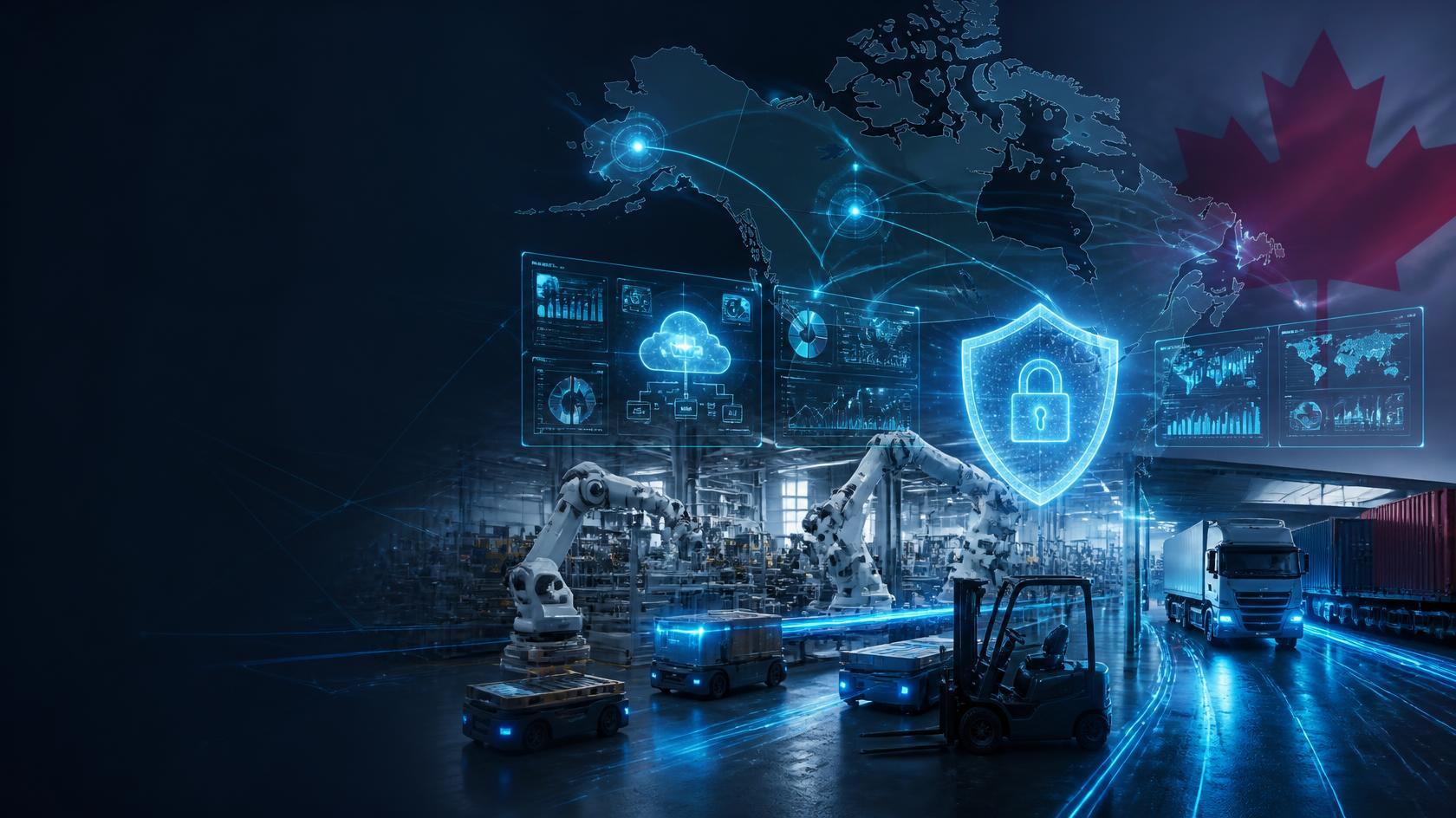
Manufacturing and logistics companies also face a unique architectural challenge that most SMBs do not: they run two different technology worlds. Enterprise IT (email, ERP, finance, HR, sales) runs on standard infrastructure with modern security expectations. Operational Technology (OT) the shop-floor equipment, PLCs, SCADA systems, warehouse scanners, and connected machinery often runs on equipment that was purchased 5, 10, or 20 years ago and was never designed to be network-connected.
The convergence of these two worlds driven by Industry 4.0, connected supply chains, and predictive maintenance has created an attack surface that most Canadian manufacturers are not fully aware of and few are adequately defending. This blog covers what a modern managed IT approach looks like for Canadian manufacturing and logistics SMBs from OT/IT segmentation and ERP security through connected equipment risk and supply chain cybersecurity.
GAM Tech has supported Canadian manufacturers and logistics companies across Calgary, Edmonton, Vancouver, and Toronto since 2012. What follows is the framework we use to help companies with 20 to 200 users bridge the OT/IT divide, secure their ERP and shop-floor systems, and meet the increasingly stringent supply chain cybersecurity requirements imposed by their larger customers.
The Unique IT Landscape of Canadian Manufacturing and Logistics
Two Technology Worlds: OT and IT
Enterprise IT (email, ERP, CRM, file storage, finance) runs on modern operating systems with regular patching, active endpoint security, and standard identity management. Operational Technology the equipment that actually makes or moves the product often runs on:
-
PLCs (Programmable Logic Controllers) with firmware from 2010 or older, no patches available.
-
SCADA/HMI systems running Windows XP or Windows 7 that can't be upgraded because the vendor no longer supports the software on newer OS.
-
Ethernet-connected CNC machines that ship from the factory with hardcoded default passwords.
-
Warehouse management scanners and printers that use unencrypted network protocols.
-
Environmental monitoring sensors that phone home to the manufacturer's cloud without your knowledge.
These OT systems were never designed for network security. They were designed to be reliable, deterministic, and never restarted mid-production. The moment you connect them to your IT network — for ERP integration, remote monitoring, or predictive maintenance you've introduced a new attack path that traditional IT security tools don't understand.
The Attack Surface Specific to Manufacturing SMBs
Canadian manufacturers face a distinct threat profile:
-
Ransomware targeting ERP and production databases — attackers know that a stopped production line creates immediate financial pressure to pay.
-
Data exfiltration of intellectual property — designs, formulas, customer lists, and supplier pricing agreements have real market value.
-
Business Email Compromise targeting accounts payable — invoice fraud through purchase order manipulation.
-
Supply chain attacks via connected vendor systems — every EDI integration, every third-party logistics portal, every supplier connection is a potential entry point.
-
OT-specific attacks against SCADA and HMI systems — increasingly targeted since 2020 by threat actors including nation-state groups.
Why Manufacturing SMBs Are Attractive Ransomware Targets
Three factors make Canadian manufacturing SMBs disproportionately attractive to ransomware operators. First, downtime costs are quantifiable and immediate a $50M/year manufacturer loses roughly $137,000 per day of production stoppage, which translates to strong economic pressure to pay quickly. Second, cyber insurance coverage in the sector often includes ransomware payment provisions, giving attackers a known settlement pathway. Third, cybersecurity maturity is generally lower than in financial services or healthcare the sector has under-invested in IT for decades relative to its risk exposure.
The IT Security Architecture for Canadian Manufacturers
OT/IT Network Segmentation: The Foundation
The single most important architectural decision for any manufacturer is OT/IT segmentation. The Purdue Enterprise Reference Architecture (Purdue Model) defines a layered approach that most Canadian manufacturers should adopt:
-
Level 0-1: Sensors, actuators, and physical process — never directly accessible from the enterprise network.
-
Level 2-3: Supervisory and site control (SCADA, HMI, historians) — accessible only through controlled interfaces.
-
Level 3.5 (DMZ): The industrial demilitarized zone — the only path between OT and IT.
-
Level 4-5: Enterprise IT (ERP, MES, business systems).
In practice for a Canadian SMB, this means: a firewall between the shop floor and the office network, no shared VLANs, no OT devices with routes to the internet, and no IT users with default access to SCADA or HMI systems. Every cross-boundary connection needs to be documented, monitored, and justified.
ERP Security: The Enterprise IT Crown Jewel
Whether you run SAP Business One, Microsoft Dynamics 365 Business Central, Sage 300, NetSuite, Epicor, or a Canadian-specific ERP like Genius Solutions or Fitrix, your ERP holds the crown jewels: customer master data, pricing, inventory, financial records, supplier agreements, and intellectual property. ERP security baseline:
-
MFA on every ERP user account, without exception.
-
Role-based access control — production planners should not see finance data, and accounts payable staff should not see design specifications.
-
API security — every ERP integration (EDI, warehouse management, e-commerce) needs authenticated, encrypted, monitored connections.
-
Audit logging retained for at least 7 years — matches most Canadian corporate record retention requirements.
-
Backup independent of the ERP vendor's cloud — you need to be able to restore from an incident that affects the ERP vendor itself.
Endpoint Security for Shop Floor and Office
Every Windows or Mac device on your network needs EDR (endpoint detection and response). This includes office workstations, engineering laptops, warehouse tablets, and critically any Windows-based HMI or SCADA workstation that runs on the OT network but sits on the IT/OT boundary. GAM Tech's Gold and Platinum plans include EDR, MDR (managed 24/7 detection & response), XDR (cross-domain), and ITDR (identity threat detection & response).
Connected Equipment: The Third Attack Vector
Modern manufacturing equipment CNC machines, injection molding systems, packaging lines, quality inspection systems increasingly ships with Ethernet or Wi-Fi connectivity for remote monitoring, firmware updates, and telemetry. Every one of these devices is a potential entry point. Baseline controls:
-
Dedicated VLAN for OT-connected equipment, isolated from enterprise IT.
-
Firewall rules that explicitly allow only necessary traffic to and from equipment.
-
Default password change and disable of factory remote access ports.
-
Documented list of every connected asset you cannot secure what you don't know exists.
-
Firmware update process that balances security patching against production risk.
Supply Chain Cybersecurity: The Increasingly Non-Negotiable Requirement
Why Your Larger Customers Now Care About Your Cybersecurity
If your manufacturing SMB supplies larger enterprises, government, or regulated industries, you are now being asked to demonstrate cybersecurity controls as a condition of continued business. This is driven by several forces:
-
The 2020 SolarWinds attack demonstrated that adversaries target small vendors to reach large enterprises.
-
The 2021 Kaseya attack demonstrated the same at scale.
-
Canadian federal contractors face increasingly strict IT security requirements through PSPC and DND.
-
Cyber insurance underwriters are asking about supply chain risk explicitly.
-
Provincial procurement policies are adding cybersecurity clauses to public sector contracts.
What Your Customers Are Asking About
Canadian manufacturing SMBs are increasingly seeing questionnaires that ask about:
-
SOC 2 certification or equivalent independent audit.
-
ISO 27001 compliance or equivalent framework.
-
NIST Cybersecurity Framework adoption.
-
Multi-factor authentication deployment.
-
Endpoint detection and response coverage.
-
Incident response plan documentation.
-
Cyber insurance coverage minimums.
-
Vendor onboarding and offboarding processes.
-
Data handling for shared customer information.
For manufacturers who cannot demonstrate these controls, the practical consequence is losing business either directly (through contract requirements) or indirectly (through slower payment terms, higher liability requirements, or being deprioritized in supplier selection).
IT Applications for Manufacturing and Logistics Operations
The Technology Stack of a Canadian Manufacturing SMB
A typical Canadian manufacturing SMB with 20-200 users runs:
-
Enterprise ERP (SAP Business One, Dynamics 365, NetSuite, Sage 300, Epicor, or industry-specific).
-
Manufacturing Execution System (MES) or shop-floor control software.
-
Customer Relationship Management (Dynamics 365 Sales, Salesforce, HubSpot).
-
Warehouse Management System (WMS) often a module of the ERP.
-
EDI (Electronic Data Interchange) for customer and supplier integrations.
-
Product Lifecycle Management (PLM) or Product Data Management (PDM).
-
Quality Management System (QMS) with SPC data capture.
-
Financial and payroll systems (often integrated with the ERP).
-
Microsoft 365 or Google Workspace for productivity.
Logistics-Specific Systems
Canadian logistics and distribution SMBs add another layer:
-
Transportation Management System (TMS) for load planning and carrier selection.
-
Warehouse control systems for conveyor, sortation, and automation.
-
Route optimization and delivery scheduling.
-
Freight audit and payment platforms.
-
Customs and cross-border compliance systems (particularly for US-Canada trade).
Each of these systems is a potential attack surface, an integration point requiring security review, and a business dependency that needs to be included in the incident response plan.
Canadian Regulatory Considerations for Manufacturers and Logistics
Canadian manufacturing and logistics companies face a lighter direct regulatory burden than healthcare or financial services, but the environment is tightening:
-
PIPEDA: applies to any personal information handled customer data, employee records, supplier contact information.
-
Provincial privacy laws: Quebec Law 25 for any Quebec residents' data; provincial equivalents in BC and Alberta.
-
PSPC/DND cybersecurity requirements: escalating for federal contractors, particularly around Controlled Goods Program and defense supply chain.
-
Provincial workplace privacy: employee monitoring, access controls, and record retention rules vary by province.
-
Environmental and safety compliance: increasingly requires IT-supported reporting and record keeping.
-
Cross-border trade compliance: CUSMA and US export controls apply to certain manufactured goods and require documented IT controls.
Managed IT providers supporting manufacturing SMBs need to understand these frameworks as they intersect with day-to-day operational IT decisions data retention policies, backup architecture, access controls, and cross-border data flows.
GAM Tech Differentiators: Managed IT for Canadian Manufacturers and Logistics
GAM Tech (GAM Technical Services Inc.) has supported Canadian manufacturing and logistics SMBs from our 8 offices across Alberta (Calgary HQ, Edmonton, Red Deer), British Columbia (Vancouver, Victoria), Ontario (Toronto, Ottawa), and Quebec (Montréal) since 2012. Bilingual English and French support in Ottawa and Montréal.
SOC 2 certified and Certified B Corporation. Ranked #97 globally / #1 in Western Canada on the 2026 MSP 501. Named to Canada's Top 50 Best Managed IT Companies for five consecutive years (2021-2025). ESET Canada MSP Partner of the Year in both 2024 and 2025. Great Place to Work-Certified Top 100 Best Workplaces in Canada.
For manufacturing and logistics SMBs specifically, our SOC 2 certification is directly relevant it's the same independent audit framework your larger customers are increasingly asking you to demonstrate. When we support your supplier questionnaires, we can point to our own SOC 2 attestation as evidence of the controls we're maintaining on your behalf.
Every Managed IT plan includes 24/7/365 support with a 5-minute response commitment delivered on 99%+ of tickets essential for production environments where a stopped line loses money by the hour. Every client has a named Client Success Manager for strategic guidance alongside a dedicated 24/7 help desk team for day-to-day tickets. Professional services on the majority of IT projects ERP migrations, OT/IT segmentation projects, cybersecurity assessments, EDI integrations are included in the plan with no separate project fees.
Pricing is per managed device (computer, server, or network device), not per user Silver plans start at $110 per managed device per month, with a $1,000 monthly minimum. Gold plans add the layered cybersecurity stack (MDR managed 24/7 detection & response, XDR cross-domain, ITDR identity threat detection, security awareness training plus ongoing phishing simulations, immutable off-site backups, Breach Recovery Guarantee) that most supply chain cybersecurity requirements now demand.
GAM Tech runs on EOS (Entrepreneurial Operating System) with a Right Person, Right Seat discipline the reason your account team understands your production environment, integrates with your operations team, and stays with you long term.
Frequently Asked Questions: IT for Canadian Manufacturing and Logistics
What is OT/IT convergence and why does it matter for Canadian manufacturers?
Operational Technology (OT) is the equipment that controls physical processes PLCs, SCADA, HMI systems, CNC machines, warehouse scanners. Enterprise IT is the standard business technology email, ERP, CRM, file storage. Historically these were separate networks with different vendors, different lifecycles, and different security models. Modern manufacturing requires them to talk to each other (predictive maintenance, real-time production data, connected supply chain), but doing so introduces cybersecurity risks that traditional IT security doesn't address. OT/IT convergence is the strategic and architectural work of connecting these two worlds securely.
How should a Canadian manufacturer segment OT and IT networks?
The industry standard is the Purdue Enterprise Reference Architecture (Purdue Model), which defines layers from physical process (Level 0) through enterprise IT (Level 4-5) with a mandatory industrial DMZ (Level 3.5) between OT and IT. In practice for a Canadian SMB, this means: a dedicated OT VLAN separated from the office network by a firewall, no OT devices with direct internet routes, and controlled interfaces for any cross-boundary data exchange (ERP integration, historian data, predictive maintenance uploads).
What cybersecurity questions are our customers going to ask us as a manufacturer or logistics supplier?
Increasingly, larger customers are asking about SOC 2 or ISO 27001 certification, MFA deployment, endpoint detection and response coverage, incident response planning, cyber insurance coverage, vendor management practices, and specific data handling procedures for shared customer information. Federal contractors face additional requirements through PSPC, DND, and the Controlled Goods Program. GAM Tech regularly supports supplier questionnaire responses for our manufacturing clients and can point to our own SOC 2 attestation as evidence of the controls we're maintaining on your behalf.
Does GAM Tech support SCADA and industrial control systems?
GAM Tech supports the IT-side infrastructure that surrounds SCADA and industrial control systems network segmentation, firewall rules, monitoring, and the Windows-based HMI or historian workstations that sit on the OT/IT boundary. For the SCADA controllers, PLCs, and industry-specific control software themselves, we work in coordination with the equipment vendor or your existing OT specialists. We do not replace domain-specific OT expertise but we complement it with modern network security and monitoring practices.
What is the difference between an ERP system and an MES system?
An ERP (Enterprise Resource Planning) system manages the business side of manufacturing finance, inventory, customer orders, purchasing, HR. An MES (Manufacturing Execution System) manages the shop floor production scheduling, work-in-process tracking, quality data capture, machine performance. Modern manufacturers typically run both, integrated to share data. From an IT security perspective, both are critical business systems requiring MFA, role-based access, audit logging, and independent backup but the MES sits closer to the OT boundary and requires additional consideration for network segmentation.
What is the biggest cybersecurity threat facing Canadian manufacturers?
The current top threat is double-extortion ransomware attackers infiltrate the network, exfiltrate intellectual property and customer data over days or weeks, then encrypt production systems and demand payment for both decryption and non-publication of the stolen data. This attack pattern disproportionately targets manufacturers because downtime costs are immediate and quantifiable (creating pressure to pay), stolen intellectual property has market value (creating additional monetization for the attacker), and manufacturing SMBs have historically under-invested in cybersecurity. The 2026 Verizon DBIR confirms manufacturing as one of the top five sectors for ransomware incidents.
How much does managed IT cost for a Canadian manufacturer or logistics SMB?
GAM Tech charges per managed device (computer, server, or network device) rather than per user. Silver plans start at $110 per managed device per month with a $1,000 monthly minimum. Manufacturers typically need Gold or Platinum tiers to meet supply chain cybersecurity requirements those higher tiers include the MDR/XDR/ITDR layered stack, ongoing phishing simulations, immutable backups, and Breach Recovery Guarantee. Contact GAM Tech for pricing specific to your device count and OT/IT environment.
What is a supply chain attack and how do we prevent one?
A supply chain attack targets a smaller supplier to reach a larger customer or targets a widely-used software or service to reach many customers at once. The 2020 SolarWinds and 2021 Kaseya incidents are the highest-profile examples. Prevention for a manufacturing SMB includes: vendor cybersecurity due diligence, restricted vendor network access, monitoring of vendor integrations, incident response plans that account for vendor compromise, and increasingly SOC 2 or ISO 27001 certification of your own IT provider so you can demonstrate to your customers that the risk of you being the compromised link is minimized.
What is an EDI integration and what security controls does it need?
EDI (Electronic Data Interchange) is the standard method for exchanging structured business documents (purchase orders, invoices, shipping notices, advance ship notices) between trading partners. Traditional EDI runs over dedicated networks (Value-Added Networks, or VANs) or increasingly over the internet using AS2, SFTP, or REST APIs. Every EDI integration needs authenticated connections, encrypted transport, transaction logging, and critically monitoring for anomalies (unusual document volumes, off-hours transmissions, changes to trading partner data) that could indicate compromise.
How should a manufacturer approach backup and disaster recovery?
Manufacturing operations require aggressive recovery targets. Recovery Time Objective (RTO) for the ERP and MES should be 4-8 hours longer and you're missing shipping windows, delaying customer orders, and losing production runs. Recovery Point Objective (RPO) should be 1 hour or less a full day of lost production data is not recoverable through manual re-entry. Immutable off-site backups are essential (ransomware operators specifically target backup systems), and quarterly tested restore procedures are the difference between 'we have backups' and 'we can recover.' GAM Tech's Gold and Platinum plans include the Breach Recovery Guarantee.
What should we look for in a managed IT provider for a manufacturer?
Look for: SOC 2 certification (your customers are increasingly asking for this); Canadian offices and staff (data residency, regulatory familiarity, ability to be on-site); manufacturing sector experience (references and case studies); OT/IT segmentation experience specifically (not just general enterprise IT); response time commitments measured in minutes (a stopped production line can't wait an hour); clear pricing model (per-device is more predictable than per-user for manufacturers); 24/7 support (production runs don't stop for business hours); and a cybersecurity stack that meets supply chain expectations. GAM Tech meets all of these criteria and is SOC 2 certified, MSP 501 top-100 globally.
IT That Understands Both Sides of the Plant Floor
Canadian manufacturing and logistics SMBs operate at the intersection of enterprise IT and operational technology two technology worlds that were never designed to work together, but now must. Layer in supply chain cybersecurity expectations from larger customers, the increasingly sophisticated ransomware threat targeting the sector, and the operational reality of production environments where downtime translates directly to lost revenue, and IT stops being a back-office function.
GAM Tech supports Canadian manufacturers and logistics companies with SOC 2 certified controls that meet supply chain expectations, OT/IT segmentation and monitoring, 24/7/365 response with a 5-minute commitment, and a cybersecurity stack that satisfies both cyber insurance underwriters and the increasingly detailed supplier questionnaires from larger customers.
Contact GAM Tech to discuss the specific IT and cybersecurity requirements of your manufacturing or logistics operation. Call toll-free 1-833-GAM-TECH (1-833-426-8324) or book a free 30-minute consultation at gamtech.ca/book-a-consultation. We serve Canadian manufacturers from 8 offices Calgary, Edmonton, Red Deer, Vancouver, Victoria, Toronto, Ottawa, and Montréal with bilingual English and French support in Ottawa and Montréal.