1 min read
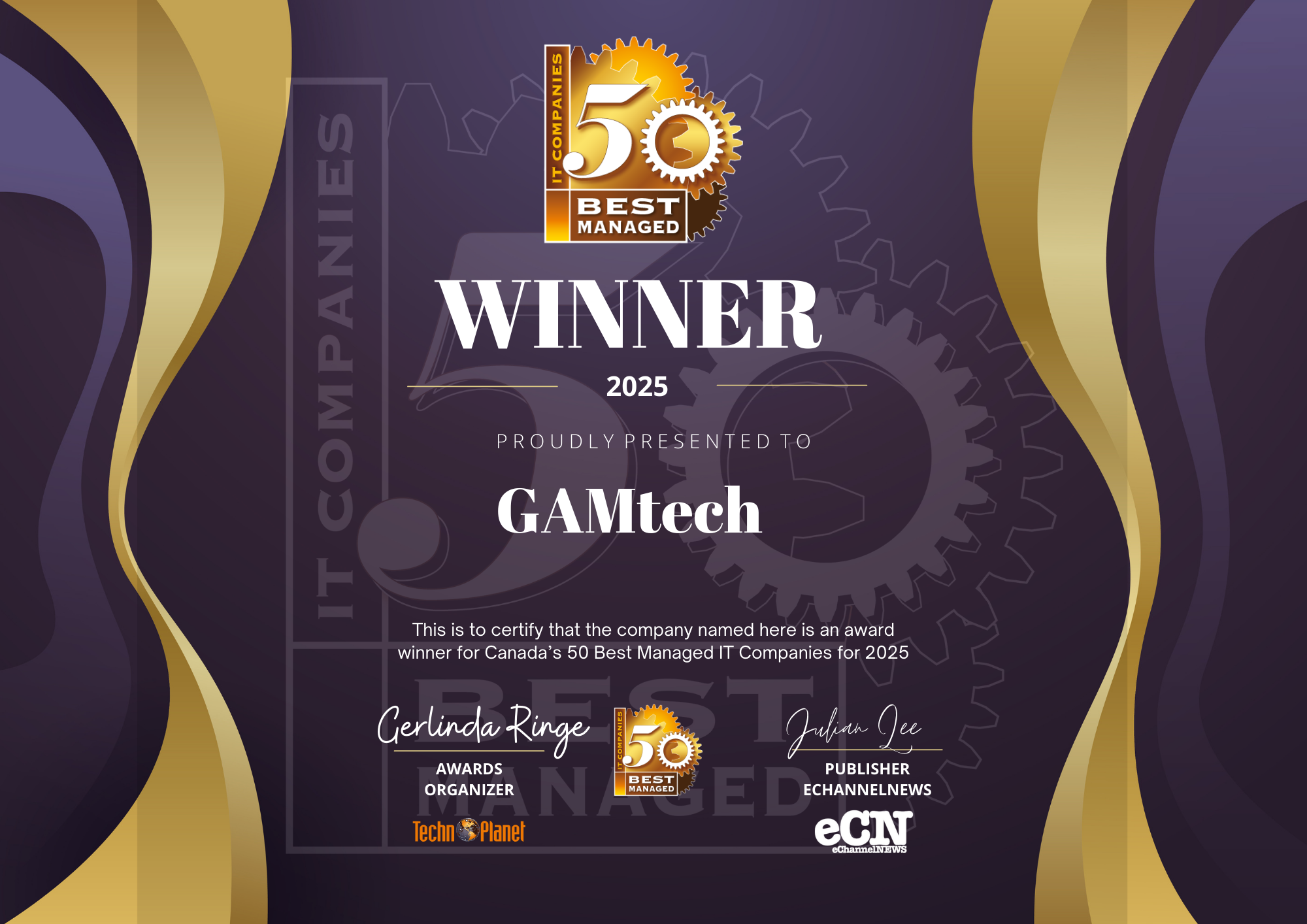
GAM Tech Named One of Canada’s 50 Best Managed IT Companies For the Fifth Consecutive Year
We’re proud to announce that GAM Tech has been recognized as one of Canada’s 50 Best Managed IT Companies for 2025 — our fifth consecutive year...
The cybersecurity landscape has fundamentally shifted. If you’re running a business with 20 to 200 employees in Canada, the threats you face in 2026 look nothing like the threats you faced even two years ago and the reason is artificial intelligence.
Cybercriminals have adopted AI faster than most businesses have. They’re using it to generate phishing emails that are virtually indistinguishable from legitimate correspondence. They’re deploying deepfake audio and video to impersonate executives and authorize fraudulent wire transfers. They’re building malware that adapts in real time to evade your security tools. And they’re doing all of this at a scale and speed that was impossible just 18 months ago.
The numbers tell the story. Data breaches hit an all-time high cost for businesses in the past year, with the average breach running into the millions of dollars in recovery, legal fees, lost business, and reputational damage. Small and mid-sized businesses accounted for over 70% of all data breaches, and 88% of ransomware attacks targeted small businesses specifically. Meanwhile, research from Vistage shows that 15.5% of SMBs still have no cyber strategy at all as we enter 2026.
At GAM Tech, cybersecurity isn’t an add-on to our managed IT services it’s the foundation. As a SOC 2 certified managed service provider, we see the threat landscape evolving in real time across our client base. This article is our comprehensive guide to what’s changed, what you’re up against, and exactly what you can do to protect your business.
To understand why 2026 feels different, you need to understand what AI has given attackers. Previously, launching a sophisticated cyber attack required significant technical skill, time, and resources. A convincing phishing campaign meant hand-crafting emails. A social engineering attack meant researching targets manually. Developing malware meant writing code from scratch.
AI has eliminated those barriers. Today, an attacker with minimal technical skill can use AI tools to generate hundreds of unique, contextually relevant phishing emails in minutes. They can clone a CEO’s voice from a few seconds of publicly available audio. They can purchase ransomware kits on the dark web that come with AI-powered evasion capabilities built in.
The result is an industrialization of cybercrime. Attacks that used to target one company at a time now target thousands simultaneously. The quality of each attack has gone up while the cost of launching it has gone down. For businesses in the 20–200 employee range big enough to have valuable data and financial assets, small enough to have gaps in their defenses this is a dangerous combination.
Traditional phishing emails were often easy to spot: poor grammar, generic greetings, suspicious URLs. AI-generated phishing is different. These emails are grammatically perfect, contextually relevant, and personalized to the recipient. They reference real projects, use the correct internal terminology, and arrive at times that make sense in the context of the recipient’s workday.
We recently helped a 75-person professional services firm in Calgary investigate a business email compromise that started with an AI-generated phishing email. The email appeared to come from a partner at a law firm the company regularly worked with. It referenced a real transaction by name, used the correct deal terminology, and requested a routine-looking document review. The only red flag was a subtly altered reply-to address and the employee who received it had no reason to check. Within 48 hours, the attackers had access to the company’s email system and were monitoring financial communications.
This is the new normal. AI allows attackers to scrape publicly available information LinkedIn profiles, company websites, press releases, social media and craft emails that are specifically tailored to their targets. The days of catching phishing by looking for typos are over.
Deepfake technology has moved from a curiosity to a genuine business threat. AI can now clone a person’s voice from as little as three seconds of audio easily obtained from a conference presentation, a podcast appearance, or even a voicemail greeting.
In one case we’re aware of, a financial controller at a mid-sized Edmonton company received a phone call that appeared to be from their CEO, who was travelling internationally. The voice was unmistakably the CEO’s. The caller explained that an acquisition deposit needed to be wired urgently and that the details would follow by email. The email arrived minutes later from what appeared to be the CEO’s account. The controller initiated the transfer. It wasn’t until the real CEO checked in later that day that the fraud was discovered.
Deepfake attacks exploit something that security tools can’t easily protect: human trust. When you hear your boss’s voice on the phone, your guard drops. Attackers know this, and they’re targeting the people in organizations who have the authority to move money or share sensitive information.
Ransomware has evolved well beyond simple file encryption. Modern ransomware operations use a technique called double extortion: they first steal your data, then encrypt your systems, and then threaten to publish the stolen data publicly unless you pay. Even if you have good backups and can restore your systems, the data exfiltration creates a separate pressure to pay.
AI has made ransomware more dangerous in several ways. AI-powered ransomware can analyze your network in real time to identify the most valuable data before encrypting it. It can adapt its behavior to evade endpoint detection tools. And it can move laterally through your network faster than a human attacker could, compromising multiple systems before your security tools raise an alarm.
The economics are stark. The average recovery time for a business after a ransomware attack is 279 days. Sixty percent of small businesses that are hacked close within six months. And the attackers have done the math: targeting thousands of small businesses with lower ransom demands yields a higher return than targeting a single large enterprise with a massive demand.
Supply Chain and Vendor Attacks
Your business might have strong security practices, but what about your vendors? Supply chain attacks target the weaker links in your business ecosystem to gain access to your systems. If your accounting software vendor, your cloud storage provider, or even your HVAC contractor has weak security, attackers can use that connection to reach you.
AI accelerates supply chain attacks by automating the process of mapping business relationships and identifying vulnerable entry points. An attacker can use AI to analyze publicly available information about your vendor relationships, identify the vendor with the weakest security posture, and craft targeted attacks against that vendor specifically to gain access to your network.
For businesses in the 20–200 user range, this is particularly concerning because you often rely on third-party vendors for critical functions but lack the resources to conduct thorough security assessments of every vendor relationship.
Credential stuffing the automated testing of stolen username and password combinations across multiple sites has been around for years. AI has supercharged it. Modern credential attacks use AI to predict likely password variations, time attacks to avoid detection, and prioritize high-value targets based on the type of data likely to be accessible.
With 80% of all hacking incidents involving compromised credentials or passwords, and one-third of small businesses with fewer than 50 employees relying on free, consumer-grade cybersecurity solutions, the credential attack surface for Canadian SMBs is enormous.
What makes the current threat landscape particularly dangerous is that these five attack types don’t operate in isolation. Sophisticated cybercriminal operations chain them together for maximum impact. An AI-generated phishing email delivers an initial foothold. Stolen credentials from that compromise are used for lateral movement. The attacker maps your network using AI-powered reconnaissance, identifies the most valuable data, exfiltrates it quietly, and then deploys ransomware for the double extortion. The entire sequence can unfold in hours rather than weeks.
We worked with a 130-person logistics company in Vancouver that experienced this exact chain of events. It started with a single phishing email to an accounts receivable clerk. Within 72 hours, the attackers had moved from that one compromised email account to the company’s financial systems, exfiltrated client contract data, and deployed ransomware across their entire network. The company was offline for nine days. The total recovery cost, including IT remediation, legal fees, client notification, and lost business during the outage, exceeded $420,000.
The lesson here is that defending against one type of attack isn’t enough. You need a layered security strategy that addresses the full kill chain from initial compromise through lateral movement to data exfiltration and ransomware deployment. Each layer of defense provides another opportunity to detect and stop an attack before it achieves its objective.
We hear this from prospective clients regularly: “We’re not big enough to be a target.” The data says otherwise. Research shows that 59% of small business owners with no cybersecurity measures believe their business is too small to be attacked. Meanwhile, small businesses face 350% more social engineering threats than larger companies.
The reason is simple: attackers are no longer manually selecting targets. AI automation means they can scan thousands of businesses simultaneously, identify those with weak defenses, and launch attacks automatically. Your size doesn’t protect you your security posture does. And if your security posture has gaps, AI will find them.
Canadian businesses face additional considerations. The upcoming changes to federal privacy legislation will introduce stronger breach notification requirements and potentially significant penalties for inadequate security practices. Getting breached isn’t just an operational problem anymore it’s increasingly a regulatory one.
Multi-Factor Authentication — Everywhere, No Exceptions
MFA is the single most effective defense against credential-based attacks. Yet only 20% of small businesses have implemented it. If you do nothing else after reading this article, enable MFA on every account that supports it email, cloud applications, VPN, remote desktop, financial systems, and administrative tools. Hardware security keys provide the strongest protection, but even app-based authentication is dramatically better than passwords alone.
We cannot overstate how important this is. When we onboard new clients at GAM Tech, MFA implementation across all systems is one of the first things we address. In almost every case, we find accounts often administrative accounts with elevated privileges that lack MFA protection. Each one of those accounts is a door that an attacker with stolen credentials can walk right through. MFA slams that door shut.
For financial transactions specifically, implement out-of-band verification procedures. This means that any wire transfer or payment change request must be confirmed through a different communication channel than the one the request arrived on. If you receive an email requesting a wire transfer, verify it with a phone call to a known number not the number in the email. This simple step defeats the vast majority of business email compromise and deepfake attacks.
Standard email filtering catches the obvious threats. AI-generated phishing requires AI-powered email security tools that analyze behavioral patterns, detect anomalies in communication patterns, and flag messages that deviate from established norms, even when the content itself looks legitimate.
Traditional antivirus is signature-based: it looks for known threats. AI-powered attacks are designed to be novel. EDR and MDR solutions use behavioral analysis to detect suspicious activity regardless of whether it matches a known threat signature. For businesses that can’t staff a 24/7 security operations center internally, partnering with an MSP that provides MDR capabilities is essential.
Follow the 3-2-1 rule: three copies of your data, stored on two different media types, with one copy kept offsite. But don’t stop at creating backups test your recovery process regularly. We’ve seen too many businesses discover that their backups are corrupted or incomplete only after they desperately need them. Your backup strategy should include air-gapped or immutable backups that ransomware can’t reach, even if your entire network is compromised.
Consider this: modern ransomware specifically targets backup systems before encrypting production data. If your backups are connected to the same network as your primary systems, a sophisticated attacker will encrypt them too. Air-gapped backups physically disconnected from your network and immutable backup solutions that cannot be modified or deleted for a defined retention period are the only reliable defense against this tactic. At GAM Tech, we implement immutable backup solutions for our clients as standard practice, because traditional backup approaches are no longer sufficient against modern ransomware.
When a cyber incident happens, the first 30 minutes determine the outcome. Do you know who to call? What systems to isolate? How to communicate with clients and stakeholders? An incident response plan that’s documented, distributed, and rehearsed transforms a crisis from chaos into a coordinated response. At GAM Tech, every client has an incident response plan that’s tested and updated regularly.
Your incident response plan should cover at minimum: who has authority to make decisions during an incident, the communication chain for internal and external stakeholders, step-by-step procedures for containing and eradicating the threat, your legal and regulatory notification obligations, contact information for your cyber insurance carrier, and the process for preserving evidence for forensic investigation. If any of these elements are missing, your plan has gaps that will cost you time and money when every minute counts.
You need to know how your vendors handle your data and what security controls they have in place. Start by identifying which vendors have access to your systems or data, assess their security practices, and include security requirements in your vendor contracts. For critical vendors, request evidence of security certifications like SOC 2.
For businesses with 20–200 users, building an internal team that can defend against AI-powered threats is both impractical and unaffordable. A single IT person no matter how talented cannot provide 24/7 monitoring, maintain expertise across cybersecurity, cloud, and infrastructure, and keep pace with the evolving threat landscape.
A SOC 2 certified MSP like GAM Tech provides an entire team of security professionals, enterprise-grade tools, and around-the-clock monitoring at a fraction of the cost of building those capabilities internally. Our SOC 2 certification means an independent auditor has verified that we have the controls and processes in place to protect your data it’s not a self-assessment, it’s an external validation of our security practices.
Let’s talk about what happens when a cyber attack actually succeeds against a small or mid-sized business. The financial impact goes far beyond the ransom payment or the immediate remediation costs.
The direct costs include incident response and forensic investigation, which typically runs $20,000 to $100,000 depending on the scope. Legal counsel for breach notification compliance adds another $10,000 to $50,000. If personal information was compromised, you may need to provide credit monitoring services to affected individuals. System restoration and data recovery, even with good backups, can take weeks of focused effort from IT professionals billing at premium emergency rates.
Then there are the indirect costs that are harder to quantify but often more damaging. Business downtime during recovery averages 279 days that’s nearly ten months of operating at reduced capacity. Client trust erodes, and some clients will leave. Your reputation in the market takes a hit that no marketing campaign can quickly fix. Employee morale suffers as the team deals with the stress and disruption of the incident. And your cyber insurance premiums if you have coverage will increase substantially at renewal.
For businesses in regulated industries, the regulatory consequences add another layer. Under Canada’s evolving privacy legislation, organizations that fail to report breaches promptly or that are found to have inadequate security measures face penalties that can reach into the hundreds of thousands of dollars. The upcoming changes to federal privacy law are expected to strengthen these penalties significantly.
A 40-person insurance brokerage in Toronto we onboarded had experienced a ransomware attack six months before engaging with us. The direct costs of recovery exceeded $85,000. But the real damage was the three clients who left during the disruption, representing over $200,000 in annual recurring revenue. The brokerage’s total cost of the incident, when factoring in lost business, remediation, legal fees, and increased insurance premiums, exceeded $350,000. For a business of that size, it was nearly catastrophic.
That’s why we emphasize prevention so strongly. The cost of implementing proper cybersecurity defenses even comprehensive ones is a fraction of the cost of recovering from a successful attack. Every dollar invested in prevention returns multiples in avoided risk.
Before we wrap up, here’s a quick self-assessment to help you gauge your current cybersecurity posture against AI-powered threats. Be honest with yourself — the gaps you identify here are the gaps attackers will find.
Is MFA enabled on all email accounts, cloud applications, VPN connections, and administrative tools? If any of these lack MFA, you have a critical vulnerability.
When was your last security awareness training session? If it’s been more than six months, or if your training doesn’t cover AI-generated phishing and deepfake attacks, your team isn’t prepared for current threats.
Do you have endpoint detection and response (EDR) on every device, or are you relying on traditional antivirus? Signature-based antivirus will not catch AI-powered attacks.
Is your backup and recovery strategy tested? Not just “we have backups” but “we’ve tested restoring from backup in the last 90 days and confirmed it works.”
Do you have a documented incident response plan, and does your team know where to find it and what to do? If the answer is “sort of” or “it’s in someone’s head,” that’s not a plan.
Do you know which of your vendors have access to your systems or data, and have you evaluated their security practices?
Are you monitoring your systems 24/7, or only during business hours? Attackers are increasingly launching attacks outside business hours specifically because they know monitoring drops off.
Do you have a process for rapid financial transaction verification that doesn’t rely solely on email or phone calls? This is essential for defending against deepfake and BEC attacks.
If you answered “no” or “I’m not sure” to more than two of these questions, your business has meaningful cybersecurity gaps that AI-powered attacks can exploit. The good news is that every one of these gaps is fixable. The question is whether you address them proactively or wait until an attacker finds them first.
Canadian businesses face some unique dynamics in the current threat landscape that are worth highlighting. First, Canadian organizations are increasingly targeted specifically because attackers perceive them as having weaker defenses than their American counterparts while handling equally valuable data. Cross-border data sharing between Canadian and American businesses also creates attack paths that cybercriminals actively exploit.
Second, Canada’s regulatory environment is in active transition. The federal government is introducing new privacy legislation and cybersecurity requirements that will materially increase the consequences of a data breach. Businesses that are breached under the new regulatory framework will face not just operational disruption, but potential regulatory investigation and financial penalties. We’ll be covering these regulatory changes in detail in our next blog post.
Third, the Canadian cybersecurity talent market is extremely tight. Finding and retaining qualified cybersecurity professionals is challenging and expensive, which makes the case for partnering with a managed IT provider even stronger. A SOC 2 certified MSP like GAM Tech gives you access to a team of security professionals without the recruitment challenges and salary competition of building that team internally.
The managed IT industry has changed fundamentally over the past two years. It’s no longer enough for your IT provider to keep your systems running and fix things when they break. In 2026, your IT partner needs to be your first line of defense against increasingly sophisticated cyber threats.
Here’s what that looks like in practice: proactive threat monitoring that identifies suspicious activity before it becomes a breach, regular security assessments that identify and remediate vulnerabilities, security awareness training that keeps your team current on the latest attack techniques, incident response planning and testing that ensures you’re prepared for the worst case, and compliance support that helps you meet evolving regulatory requirements.
At GAM Tech, we provide all of this as part of our managed IT service. With 24/7 internal support, a 5-minute response time commitment, and offices across nine Canadian cities, we’re built to provide the kind of security coverage that AI-powered threats demand. Our SOC 2 certification isn’t just a badge it’s an independent verification that our security controls, processes, and practices meet the standards required to protect your business in today’s threat environment.
We’ve seen firsthand what happens when businesses take cybersecurity seriously versus those that treat it as an afterthought. The difference isn’t just in whether they get attacked everyone gets probed and tested. The difference is in whether an attack succeeds, how quickly it’s detected, and how effectively the business responds and recovers.
The businesses that are most vulnerable to AI-powered cyber attacks are the ones that assume it won’t happen to them. The businesses that are best protected are the ones that take proactive steps today — implementing the right defenses, training their teams, and partnering with a managed IT provider that takes security as seriously as they do.
If you’re not confident in your current cybersecurity posture, or if you haven’t had an independent security assessment in the past 12 months, now is the time to act. The threat landscape will only get more challenging from here. AI-powered attacks are not a future risk — they’re a present reality, and the businesses that acknowledge that reality and act on it are the ones that will be standing strong when others are scrambling to recover.
1 min read
We’re proud to announce that GAM Tech has been recognized as one of Canada’s 50 Best Managed IT Companies for 2025 — our fifth consecutive year...
The GAM Tech 2023 Roadshow recently concluded, and it was a three-day extravaganza of tech insights, innovations, and discussions. This year's event...