
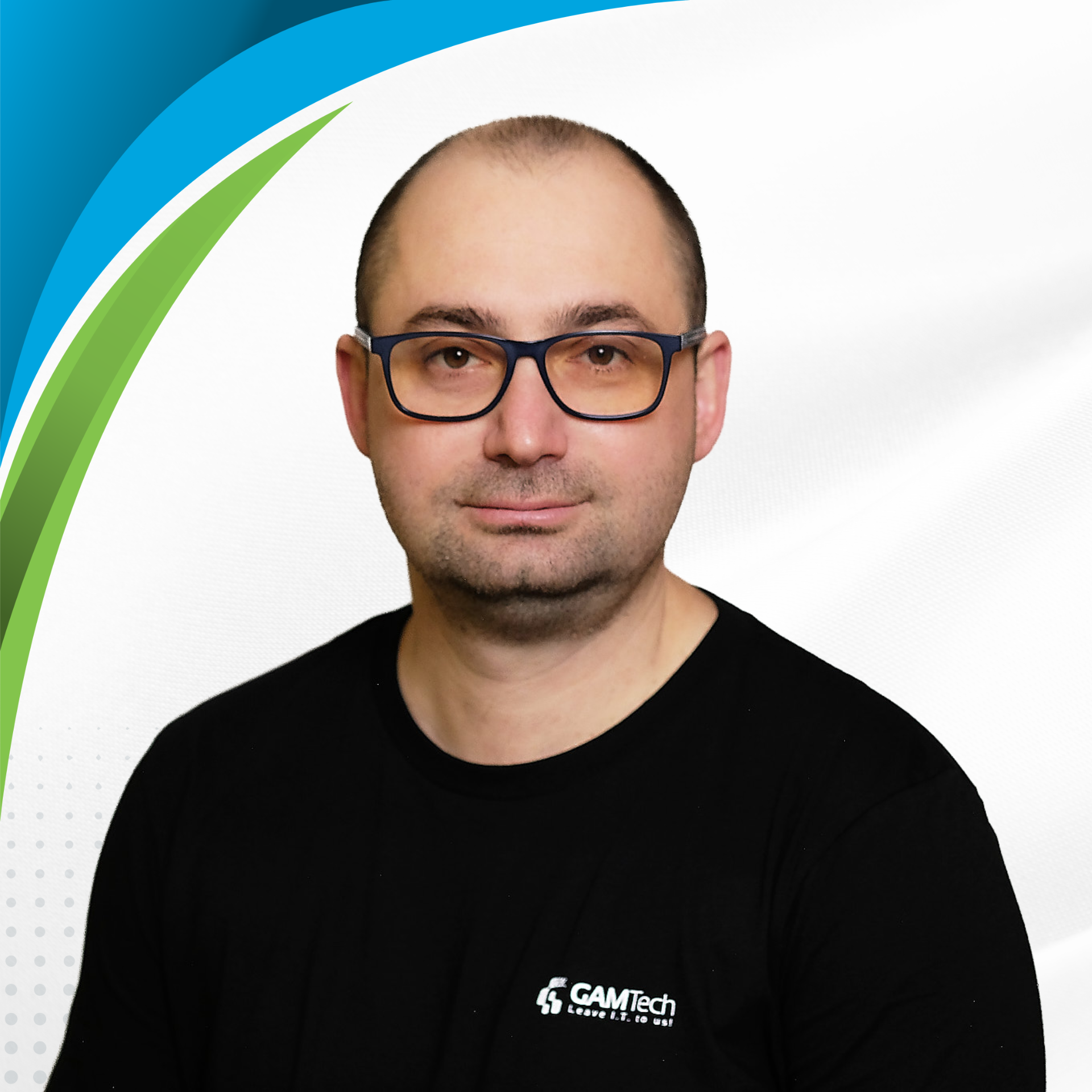
 Adrian Ghira

AI Cyber Attacks Targeting Canadian Businesses in 2026
 Adrian Ghira : Mar 6, 2026, 9:00:01 AM
AI-powered phishing, deepfake fraud, and adaptive ransomware are targeting Canadian SMBs at scale. Learn what these attacks look like and how to...
CALGARY, AB: GAM Tech has been named to the 2026 MSP 501, the managed services industry's most rigorous and respected ranking of global MSP excellence. GAM Tech placed No. 97 overall worldwide, a jump from No. 466 in 2025, and ranks No. 2 in Canada and No. 1 in Western Canada.
For a company built without outside capital, growing one client relationship at a time since 2012, this is the kind of result that validates a decade of decisions that weren't always the easy ones. It's worth taking the time to explain not just what happened, but why it happened, and what it actually means for the businesses GAM Tech serves.
Most "best of" lists in the technology channel are built on a single input: revenue. Submit your top-line number, get ranked against everyone else who submitted theirs, and call it a day. That approach rewards size. It does not reward quality, sustainability, or the kind of operational discipline that determines whether a managed services provider will still be a reliable partner five or ten years from now.
The MSP 501 was built differently. Rather than asking "how big are you," the survey asks a more useful question: "how well are you run." That means looking at the proportion of revenue that comes from predictable, recurring contracts rather than one-off projects. It means examining profit margin as a signal of operational discipline, not just growth for growth's sake. It means weighing financial health and viability over time, not a single strong quarter. And it means accounting for the breadth and depth of the services being delivered, because an MSP that only knows how to manage a help desk is a very different business than one capable of supporting security, cloud, compliance, and strategic technology planning under one roof.
This is why the ranking carries weight in the channel. It isn't a pay-to-play list, and it isn't a popularity contest decided by votes or social media engagement. It's a quantitative exercise built in collaboration with industry experts and past winners, designed specifically to separate MSPs that are well-run from MSPs that are simply well-marketed. Making the list at all is a meaningful achievement. Climbing the list significantly in a single year is a much rarer thing, and it's exactly what happened here.
A jump of this size doesn't happen by accident, and it doesn't happen overnight. The MSP 501 methodology rewards compounding decisions: the client retention strategy from two years ago, the security investment made last year, the recurring revenue contract structure that's been refined over multiple sales cycles. A result like this is really a lagging indicator of a lot of unglamorous, behind-the-scenes work that doesn't always make for exciting marketing copy in the moment it happens.
The Western Canada placement is the one that means the most close to home. Calgary and the broader Western Canadian market have no shortage of capable IT providers, many of them long-established and well-respected in their own right. Earning the No. 1 spot in that environment, on a methodology that specifically rewards financial discipline and recurring revenue health rather than raw size, says something specific about how GAM Tech has chosen to build its business: methodically, profitably, and with an eye toward long-term sustainability rather than short-term top-line growth.
The national result, No. 2 in Canada, tells a similar story at a larger scale. Canada's managed services market includes providers backed by private equity, providers that have grown through aggressive acquisition strategies, and providers with national sales infrastructure built over decades. Placing second nationally as an independently built, debt-free, founder-led business is a result worth sitting with for a moment, because it suggests that the things this industry's most rigorous ranking actually measures, financial health, recurring revenue strength, and operational discipline, are achievable without the capital structure many assume is required to compete at that level.
None of this happened by following a playbook borrowed from somewhere else. GAM Tech has been built on a specific, sometimes contrarian, set of choices, many of which take longer to pay off than the alternative would have, but which compound in exactly the way a ranking like the MSP 501 is designed to detect.
The most foundational of these choices is treating security as the starting point of the business rather than an upsell. Most MSPs add security services as a line item after the core relationship is established. GAM Tech approaches it the other way around: every client engagement starts from the assumption that security is the baseline expectation, not an optional enhancement. In a threat landscape where small and midsized businesses are targeted precisely because they're assumed to have weaker defenses than large enterprises, that posture isn't a marketing angle, it's the entire reason the business exists in its current form.
This shows up in how engagements are scoped, how staff are trained, and how technology decisions get made internally before they're ever recommended to a client. It's a slower, more deliberate way to build an MSP than simply reselling whatever hardware or software generates the best margin. It is also, not coincidentally, the kind of approach that produces the long-term client retention and recurring revenue stability that rankings like the MSP 501 are specifically designed to reward.
Anyone can claim to take security seriously. Far fewer organizations are willing to subject themselves to the scrutiny of an independent audit and earn a SOC2 certification, which requires demonstrating, to an outside party, that internal controls around security, availability, and confidentiality actually hold up under examination. GAM Tech has done exactly that.
Alongside SOC2, GAM Tech also holds B-Corp certification, which is a different kind of audit altogether. Where SOC2 examines security controls, B-Corp certification examines the full picture of how a business treats its employees, its community, and its environmental footprint, and measures it against a rigorous third-party standard. Very few managed services providers hold both certifications simultaneously, because doing so requires a level of operational maturity and intentionality that's genuinely difficult to fake. Both certifications represent ongoing commitments, not one-time achievements; they require continuous evidence, not a single audit that gets filed away and forgotten.
The other major structural decision behind GAM Tech's growth has been running the business on the Entrepreneurial Operating System, commonly known as EOS. For a services business, the temptation is always to let the urgent crowd out the important: today's client emergency takes priority over the strategic plan, and before long the strategic plan stops existing in any meaningful form. EOS exists specifically to prevent that drift, by forcing a disciplined cadence of goal-setting, accountability, and review that doesn't get skipped just because the week got busy.
Running on EOS doesn't make for an exciting headline on its own. But it's exactly the kind of unglamorous operational discipline that, compounded over years, produces the recurring revenue strength and financial consistency the MSP 501 methodology is built to detect. A business that knows where it's going, reviews its progress on a fixed schedule, and holds its own leadership accountable to the plan is a fundamentally different animal than one that's simply reacting to whatever client fire is loudest that week.
It would be easy to treat a single ranking as an isolated win and move on. But this result doesn't exist in isolation. It sits alongside a run of other recognition GAM Tech has earned, including being named ESET MSP Partner of the Year, a placement on Canada's list of Best Managed MSPs, Great Place to Work certification, and recognition among Canada's Most Admired Corporate Cultures.
Each of those recognitions measures something slightly different. ESET's award reflects performance and partnership specifically within the security vendor ecosystem. The Best Managed MSPs list, like the MSP 501, looks at operational and financial fundamentals. Great Place to Work measures the employee experience directly, through confidential surveys of the people actually doing the work. The Most Admired Corporate Cultures recognition looks at culture as a sustained organizational asset rather than a one-time perk.
What ties all of them together is that none of them can be purchased, gamed, or won through marketing spend alone. They each require sustained performance across a period of time, verified by an outside party using a defined methodology. Taken individually, any one of these could be dismissed as a fluke or a favorable year. Taken together, they describe a pattern: a business that performs well, treats its people well, and has built the kind of internal discipline that shows up consistently across very different evaluation criteria.
If your business already works with GAM Tech, this recognition isn't really about you needing to do anything differently. It's confirmation that the partner you chose is being independently validated as one of the best-run organizations in its category, not just by GAM Tech's own marketing, but by a rigorous, externally administered methodology that GAM Tech doesn't control.
It's also a signal about continuity. One of the quieter risks of working with any IT provider is the possibility that the relationship outgrows the provider's ability to deliver, or that financial instability on the provider's side eventually becomes your problem too, in the form of declining service quality, staff turnover, or worse. A ranking built specifically around financial health and recurring revenue strength is, in a very practical sense, a signal about the durability of the partnership you're already in.
If you're not yet a GAM Tech client and you're in the process of evaluating managed service providers, this is a good moment to talk about how to actually vet one, because most of the obvious signals buyers rely on turn out to be weak ones.
A polished website doesn't tell you much. Neither does a long list of vendor logos on a homepage, since nearly every MSP resells from a similar pool of vendors. Client testimonials are useful, but they're also selected by the vendor, which means they're not exactly an unbiased sample. Price is the signal buyers lean on most heavily, and it's often the least reliable, because the cheapest provider and the most expensive provider can both be poor choices for very different reasons.
Independent, methodology-driven recognition is a better signal, precisely because the organization being evaluated doesn't control the outcome. A SOC2 certification means an outside auditor examined internal controls and was willing to put their name behind the result. A B-Corp certification means an outside body evaluated the business's full impact, not just its sales pitch. A ranking like the MSP 501 means a third party collected confidential financial and operational data and ran it through a defined methodology designed to detect exactly the kind of sustainability and discipline that's hard to fake in a sales conversation.
None of that replaces the conversations you'll have directly with a prospective provider, the references you'll check, or the gut sense you'll develop about whether the team understands your business. But it's a useful filter for narrowing the field before those conversations happen, and it's part of why GAM Tech treats certifications and rankings as something worth pursuing seriously rather than as marketing decoration.
Calgary, and Western Canada more broadly, has developed into a genuinely competitive market for managed IT services over the past several years. The region's economy spans energy, construction, professional services, manufacturing, and a growing technology sector, and that diversity has attracted a correspondingly diverse set of IT providers, ranging from small, founder-led shops to regional players with multiple offices to the local arms of larger national and international firms.
Competing in that environment and earning the top ranking on a methodology built around financial discipline rather than size is a meaningfully different achievement than simply being the biggest or the most visible provider in the market. It suggests that the fundamentals GAM Tech has prioritized, security-first delivery, independent certification, and disciplined operational execution, hold up even when measured against a deep and genuinely capable field of competitors.
It also says something about what Western Canadian businesses are increasingly looking for when they choose a technology partner. The era when "we'll fix your computer when it breaks" was an acceptable value proposition for an IT provider has been over for a long time. Today's businesses, across nearly every sector represented in this region, are looking for partners who understand security as a baseline requirement, who can speak credibly to compliance and risk, and who bring the operational maturity to be a long-term partner rather than a reactive vendor. The market has rewarded providers who built for that reality early, rather than those who are still catching up to it.
A ranking like this is, by its nature, a snapshot of where a business stood during a specific evaluation window. It's not a finish line, and treating it as one would be a mistake. The same disciplines that produced this result, security-first delivery, independent certification, disciplined operating rhythm, and a relentless focus on recurring revenue health over short-term project wins, are the same disciplines that have to keep being applied going forward for the next evaluation to tell a similarly strong story.
What this result does provide is useful external validation that the approach is working, at a moment when it would be easy for any growing services business to second-guess the slower, more deliberate path in favor of faster but less durable growth. It's a reminder that building a managed services provider around genuine security expertise, independently verified operational discipline, and a long-term view of client relationships is not just the right way to build the business; according to one of the industry's most respected and rigorous methodologies, it's also a competitive advantage.
The work that produced this result doesn't stop because the result was announced. If anything, a recognition like this raises the bar for what clients, prospective clients, and the broader market should expect going forward, and that's exactly the kind of pressure that tends to produce the next year's worth of compounding decisions.
It's worth pausing on why a metric like "recurring revenue" shows up so prominently in a methodology like the MSP 501, because on the surface it sounds like an internal financial detail that has nothing to do with the experience of being a client. In practice, it's one of the more important signals a buyer can look for, even if most buyers never think to ask about it.
An MSP whose revenue is dominated by one-off projects has a fundamentally different incentive structure than one built on long-term recurring contracts. A project-driven business is incentivized to sell you the next project, whether or not it's the thing your business actually needs most right now. A recurring-revenue business is incentivized to keep your environment healthy, your risk low, and your experience positive over the long run, because the entire model depends on the relationship continuing rather than on closing the next transaction.
This also affects staffing and continuity in ways that are easy to overlook until they become a problem. A services business with unpredictable, project-based revenue has a harder time justifying investment in things that don't generate immediate billable hours: ongoing staff training, redundant coverage so a single departure doesn't create a service gap, or building institutional knowledge about a client's environment that outlasts any individual technician. A business with strong recurring revenue can make those investments with more confidence, because the revenue underwriting them is more predictable.
None of this is visible in a sales pitch. It shows up over years, in whether your environment keeps getting more secure and more efficient over time, or whether you find yourself re-explaining your setup to a new technician every few months because turnover is high and institutional knowledge keeps walking out the door. Recurring revenue strength is, in a very real sense, a proxy for whether the partner you're evaluating is built to actually be a long-term partner, or whether that language is just how project-based vendors describe themselves in a pitch deck.
The security-first posture that underpins GAM Tech's approach didn't emerge in a vacuum. It reflects a threat landscape that has changed substantially for small and midsized businesses, and a compliance environment that has changed right alongside it.
For a long time, the conventional wisdom was that smaller businesses were unlikely targets for serious cyberattacks, on the theory that attackers go after large enterprises where the potential payoff is bigger. That assumption has been thoroughly inverted. Attackers increasingly target smaller organizations precisely because they're assumed to have weaker defenses, less dedicated security staff, and a lower likelihood of detecting an intrusion before damage is done. A smaller business is often not the final target at all, but a stepping stone into the systems of a larger partner, supplier, or client further up the chain.
At the same time, the compliance expectations placed on smaller businesses have grown substantially, often as a direct consequence of contractual requirements from larger customers, insurance carriers, or industry regulators. A business that once could get by with informal IT practices may now find that a major client, an insurance renewal, or an industry certification requires demonstrable security controls, documented incident response procedures, and evidence of ongoing risk management. Many smaller businesses are not equipped to navigate that shift internally, which is exactly the gap a security-first MSP is built to fill.
This is the environment that makes a security-first model, rather than a security-as-an-upsell model, the more responsible way to build a managed services business. It's also the environment that makes independent certifications like SOC2 increasingly relevant to clients directly, rather than just to the MSP's own internal operations, because clients are increasingly being asked by their own customers and partners to demonstrate that their vendors meet a credible security standard.
While SOC2 speaks directly to security and operational controls, the B-Corp certification GAM Tech holds speaks to something broader: how the business treats the people and the community around it, evaluated against an external, rigorous standard rather than self-reported claims.
B-Corp certification examines governance, worker treatment, community impact, and environmental practices, and requires ongoing recertification rather than a one-time badge. For a client choosing a long-term technology partner, this matters for reasons that go beyond ethics in the abstract. A business that treats its employees well tends to retain them longer, which directly affects the continuity and institutional knowledge clients depend on. A business with strong governance practices tends to make more consistent, less erratic decisions over time. And a business that takes its broader community impact seriously tends to think in longer time horizons generally, which is exactly the orientation you want from a partner managing critical technology infrastructure.
Few managed services providers pursue B-Corp certification alongside SOC2, in part because the two audits examine almost entirely different things and both require sustained organizational commitment to maintain. Holding both is a structural choice, not a marketing flourish, and it's part of why this recognition lands as confirmation of an existing approach rather than a surprising departure from it.
What is the MSP 501, and who runs it?
The MSP 501 is an annual global ranking of managed service providers, produced through a survey and quantitative methodology developed by the organization behind Channel Partners and MSP Summit, in collaboration with industry experts and past winners. Unlike rankings based purely on self-reported revenue size, the MSP 501 methodology weighs recurring revenue strength, profit margin, operational efficiency, and overall financial health.
Why does a ranking based on financial metrics matter to a business choosing an IT provider?
Financial health and recurring revenue strength are strong proxies for whether a provider is built to be a stable, long-term partner. A provider with weak financial fundamentals is more likely to experience staff turnover, declining service quality, or instability that eventually becomes the client's problem. A ranking built around these metrics gives buyers an independently verified signal that's much harder to find through a sales conversation alone.
What does "security-first" actually mean in practice?
It means security is treated as the starting assumption for every engagement rather than an optional add-on. Decisions about technology, staffing, and client recommendations are made with security as a baseline requirement, not a line item that gets proposed after the core relationship is already established.
Why pursue both SOC2 and B-Corp certification?
The two certifications examine almost entirely different things. SOC2 validates security and operational controls through an independent audit. B-Corp validates the broader treatment of employees, community, and environmental impact through a separate independent standard. Holding both requires sustained commitment across very different dimensions of the business, which is part of why relatively few managed services providers pursue both simultaneously.
Does a strong ranking mean existing clients need to do anything differently?
No. The recognition is confirmation of an existing approach, not a signal of change. Clients should expect continuity in how their environment is managed, with this result serving as independent validation of the partnership they're already in.
Recognition like this tends to raise expectations rather than lower them, both internally and among the clients and prospective clients who see it. That's the right outcome. A ranking built around financial health, recurring revenue strength, and operational discipline is only meaningful if the underlying behaviors that produced it continue, and the intention is for this result to be a checkpoint along a longer trajectory rather than a peak to be remembered fondly later.
The same approach that produced this result, security-first delivery, independently verified operational standards, and a deliberate, EOS-driven operating rhythm, will continue to guide how the business is run going forward. If the methodology behind the MSP 501 is doing its job, that consistency should continue showing up in next year's results as well.
For now, the result stands on its own as a useful piece of external validation: an independently administered, rigorously designed methodology looked at how GAM Tech is run, financially and operationally, and placed it among the best managed service providers in the world, the best in Canada outside of one other organization, and the best in Western Canada outright. That's a meaningful data point for any business currently weighing whether its technology partner is built for the long term, and it's a meaningful data point for GAM Tech internally as confirmation that the harder, slower path of building a security-first, independently certified, operationally disciplined business was the right one to take.
GAM Tech is a security-first Managed IT Services Provider headquartered in Calgary, Alberta, serving small and midsized businesses across Canada. Founded in 2012 and built without outside capital, GAM Tech holds SOC2 and B-Corp certifications and runs on the Entrepreneurial Operating System (EOS), with a focus on recurring revenue strength, operational discipline, and long-term client partnerships over short-term project work.
GAM Tech is led by Adrian Ghira, CEO and Managing Partner.
Learn more at gamtech.ca.
Adrian Ghira
CEO and Managing Partner, GAM Tech
adrian@gamtech.ca
 Adrian Ghira : Mar 6, 2026, 9:00:01 AM
AI-powered phishing, deepfake fraud, and adaptive ransomware are targeting Canadian SMBs at scale. Learn what these attacks look like and how to...
 Adrian Ghira : Sep 17, 2026, 9:00:00 AM
Enterprise and government customers now audit their suppliers’ cybersecurity before renewing contracts. This 2026 guide covers what Canadian SMBs are...
 Adrian Ghira : Sep 30, 2025, 3:25:43 PM
GAM Tech is proud to be named one of Canada’s Top Growing Companies 2025 by The Globe and Mail. See what this milestone means for our clients and...